
クリスマスツリーがふたつあるよ(I found two Christmas trees!) / Kasane Teto + Hatsune Miku e^(-λt)
- Title: クリスマスツリーがふたつあるよ (I found two Christmas trees!)
- Singers: Kasane Teto + Hatsune Miku e^(-λt)
- Music/Lyrics: tomii
Video
Lyrics
This is pseudo-Celtic music. Please forgive me since it’s using D key.
It’s a song about two who were close friends but stopped meeting as time passed, and when she suddenly remember her, feeling lonely.
Japanese
僕とまだ暇な君が反対の色を合わせて
狭いテーブルを揺らして
僕を見て君が言った「クリスマスツリーがふたつあるよぉ」
変な子だなって思ったね

君とまだ触れ合う距離で緩やかな時を過ごして
狭いソファで寄り添い
懸命な君を見ていて、ふざけたくなっちゃったんだ
ちょっと恥ずかしかったけど

理由は知らないけれど、仲良くなれた気がして

クリスマスツリーはひとつでいい
僕たちはここにいるから
同じものを見てられるように
共にこのまま歩いていこう
できる限りね

いつしか違う道を通り 交わることも少なくなった
きっと来年には会えるかな?

煌びやかさが君を囲み スクリーンに映る星となった
きっと忙しいんだろうね

街を彩る光とツリー、幾らあっても寂しくて

クリスマスツリーがふたつあるよ、なんて
急に思い出して呟いてみたら
どこかに君が見える気がしたんだ
マッチを擦ったわけでもないのに
……元気にしてるのかい?

クリスマスツリーはひとつがいい
君と僕とで同じものを見ていたいから
降り積もる雪が解けてなくなるように

またいつか会えるだろうか?
Reference:
- The Little Match Girl (Den lille Pige med Svovlstikkerne)
- A story where what you want appears when you strike a match
English
It might contain wrong expressions.
I and you having free time, overlaid our opposite colors,
wobbling the little table in front of us.
You suddenly said to me, "I found two Christmas trees!"
I thought you are a quirky girl.

I had relaxed time very close to you,
cuddling up to you on the little sofa.
Seeing you hardworking, I wanted to joke around
with a little shame suppressed.

Without searching the reasons we have,
we intuitively knew we can be together.

We need only a single Christmas tree,
'cause we are sharing the same time and place.
To having the same things in our sights,
let's walk along together as we are doing
while it's being possible.

After years, we've took different ways and
we rarely see each other.
I wonder if we could meet the next year.

You've become the splendid twinkle star only seen in screens.
You might be busy as I can't expect.

Lights and trees are filling the city
but they never fill this empty feeling.

"I found two Christmas trees.",
the words suddenly remembered about popped out of my mouth.
I thought I could see your face by that,
like the little match girl did by lighting.
...How are you doing?

I need only a single Christmas tree,
'cause I want to see what you see.
Fallen snow vanishes by thawing.

I wish I could see you someday.
Note
Note
This section is translated by Claude 4.5 sonnet.
- The mysterious symbol in the title
e^(-λt)represents exponential decay, which describes things that decrease over time - Depending on your speakers, the wind chimes in the chorus might be too loud
- I couldn’t write a happy Christmas song, so I made it a song about parting
- I like Celtic music but can’t play it, so I’m not sure if this is really Celtic music
- Why do songs about two people always end up in 3/4 time? (Another song “To You Who Are Infinitely Away” is the same)
- By the way, I slightly borrowed the outro melody from that song in the interlude before the final chorus
- Teto-chan with her drills down in the second half looks cute like a lop-eared rabbit
- Having two Christmas trees would probably be in the way
- When I came up with the idea of making the drills look like Christmas trees, I thought it was the discovery of the century
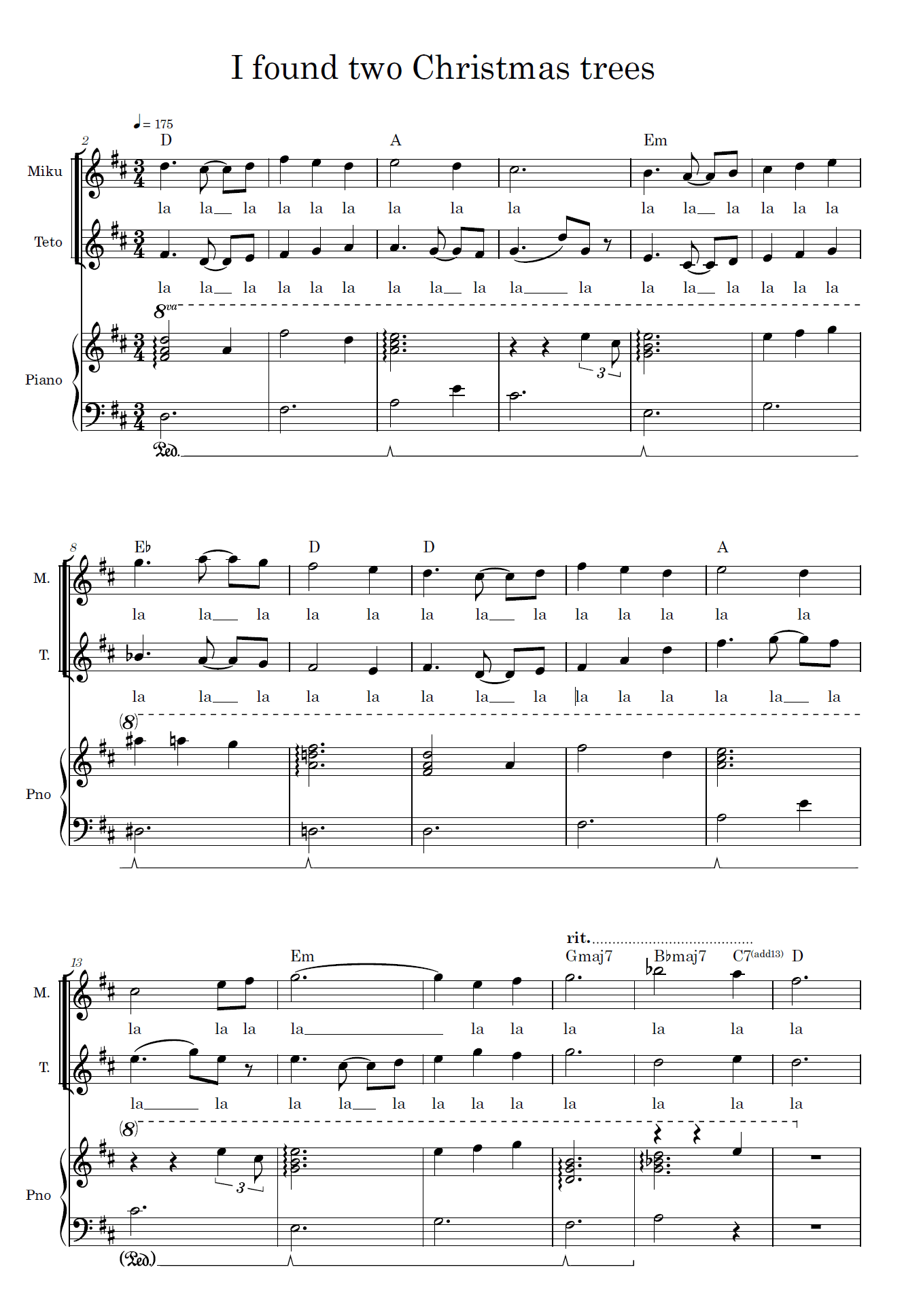
Opening Sheet Music
Created using Cubase’s score function.
Music Analysis (for study)
Note
This section is translated by Claude 4.5 sonnet.
I made it myself, yet I don’t understand it.
Eb(bII) seems to be a substitute dominant in D key, but I don’t know if it needs to be a seventh chord.Bbmaj7(bVImaj7) is a borrowed chord from D natural minor, a parallel key chord. I interpret it arbitrarily as feeling good because it’s a chord 3 semitones above the immediately precedingGmaj7(IVmaj7).- I like going up 3 semitones, so I use it frequently, not just here.
- The following
C7+13, C7 itself is also a borrowed chord from the parallel key, but due to the melody, add13 is included, making it sound bossa nova-like.- Normally, I feel like the dominant chord in D major would be
A7(V7), butAm7(IIIm of F), which is also a parallel key and substitute for the tonic chord with similar component notes, would probably work too. - The component notes of
Am7andC7+13are almost the same. - And, I hadn’t thought that far, but when I played the chord, this felt right, so I went with
C7+13. - Honestly, it’s just for a moment, and the actual sounding notes are just the two notes E and A, so it probably doesn’t really matter.
- Normally, I feel like the dominant chord in D major would be
I had an image of Celtic music being in D major or A major key, but when looking at sampling sound sources, there are surprisingly Eb and Bb keys. It might vary depending on the key of flute-type instruments. In this case, drone sounds and violin would seem harder to play, but I wonder how it actually works.
Introduction to the Instruments
Note
This section is translated by Claude 4.5 sonnet.
I’ll introduce the instruments that appear in the song. There are no images at all, but if you’re interested, please look them up yourself (throwing it all to you)
Tin whistle
In the video, around 0:38, it’s the high-pitched flute that starts playing on the left side. When you say “Celtic music,” this is THE instrument that comes to mind.
Low whistle
This is a lower-range version of the tin whistle. In the video, it starts playing on the right side at about the same time as the tin whistle.
Bagpipe (Galician bagpipe)
When I looked it up, it’s apparently a bagpipe from the Galicia region (Spain), and I realized I was using an instrument that’s not from Ireland. However, the roots themselves are apparently from the so-called Celtic people, so it’s okay. I’m calling it Celtic music, not Irish, after all.
It seems that the term “Celtic people” itself doesn’t specifically refer to Ireland. In fact, it doesn’t even refer to a specific ethnic group.
As an instrument, it’s your typical bagpipe. It starts playing on the right side at about the same time as the tin whistle. Bagpipes sometimes continuously play a constant bass sound called a drone, which seems to be a mechanism commonly found in folk music. It’s actually playing in the song, but you can barely hear it.
Fiddle
When you hear “fiddle,” you might wonder what it is, but it’s a violin. The addition of ornamental notes gives it a Celtic music finish.
This doesn’t matter to listeners, but string instruments tend to sound strangely fake in programmed music, and especially violin is a prominent instrument, so it often ends up sounding “so fake~”.
Therefore, I’ve hidden it in the song by keeping the volume a bit lower.
Guitar
It’s an acoustic guitar. There’s probably nothing too special about it, but like the fiddle, the addition of ornamental notes makes it sound Celtic.
In the song, it’s constantly playing rhythm in the background except during the intro.
Bouzouki
Pronounced “bouzouki,” it’s apparently an instrument used in Greek music, but may be widely used in Europe. It’s similar to a mandolin but seems to have a slightly higher pitch.
I feel like a mandolin would be more appropriate for Celtic music, but this fit the song better, so I used it (sounds professional here)
In the song, it’s creating rhythm together with the guitar throughout, except for the intro.
Concertina
It’s an instrument similar to an accordion, but hexagonal in shape. Apparently, its selling point is a more rustic tone than an accordion. I used it as an accordion without knowing much about it, so I might be producing sounds that can’t actually be played.
It starts playing on the left at about the same time as the tin whistle.
The accordion-like tone that comes in afterward, moving around left and right, is actually a real accordion. This one is not a concertina. Confusing, isn’t it?
Percussion instruments
I’m using snare and bass drum from the Celtic music library, but when I listen to the result, honestly it just sounds like playing a regular drum set.
But ethnic percussion instruments have strong quirks, so maybe it’s good that it turned out this way.
Organ
What’s playing on the left side around 1:08 is an organ. You sometimes hear it in jazz or old rock music.