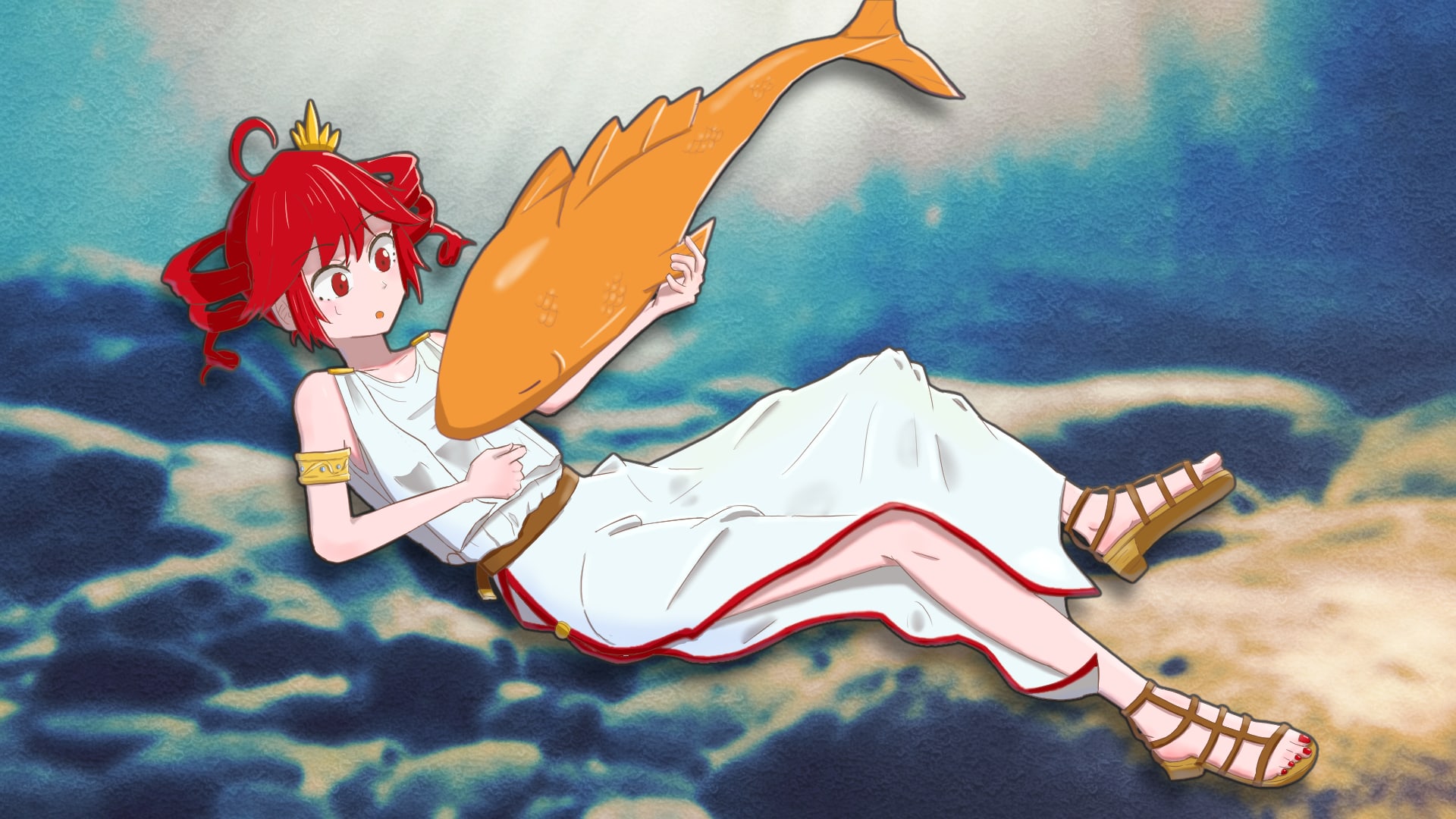
アストライアは泣いていたか? / 重音テト
- 題名: アストライアは泣いていたか? ( Did Astraea Weep? )
- 歌: 重音テト SV (V1)
- 作詞・作曲: tomii
- ジャンル: 地中海風吟遊詩人ジャズ (Mediterranean-style bard jazz)
Note
This article is translated by Claude Sonnet 4.6.
Video
Lyrics
I made this because the description of Astraea in Greek mythology as “the last deity to leave the earth” was just too cool. I wrote about Astraea and the Great Flood, but there’s no such actual legend, so this is essentially fan fiction.
It is said that Astraea herself became the constellation Virgo, or that the scales she carried became Libra.
The mysterious language at the end of the lyrics is Latin, borrowed from the source material I referenced. Sorry if I got the pronunciation wrong. The lines in double quotation marks are Astraea’s dialogue. Try reading them with feeling!
Japanese
Astraeaは泣いていたか?
信じたものに激怒したか?
流れる水の中、伸ばされる手に
瞳を投げかけたか?

"The flood will take you away,
All that stands shall turn to decay."
(洪水が皆を飲み込み
 全てのものが流されるだろう)

"All the stains shall be erased
from this iron world, debased."
(この堕落した鉄の世界から
 すべての汚れは取り除かれなければならない)

狭い世界の中 混ざる事も 厭わず
貰い物を歓び 祀ることも 忘れず
まだ このまま続いて
溢れる様な 豊穣の時を 絶やさないように

いつからの事だろうか
正義を説き始めたのは?
堕落する人々を見捨てるほどに
冷たくなれなかった

錆びついて 君の気が済めば
冬も、諍いも消えるのだろうか?
夏と秋と 海を渡り始め
全て沈む 直前まで 秤となって

"I'm still with you."
(私はまだ共にいる)

iamque nocens ferrum ferroque nocentius aurum
prodierat, prodit bellum, quod pugnat utroque,
sanguineaque manu crepitantia concutit arma.
(そして害なす鉄と罪深き金が現れ
 その両方を使った争いが起きた
 血塗られた手で武器を打ち鳴らし振るっていた)

秤さえも空へ昇る

"And the flood did take them away."
(そして彼らはいなくなった)
English
Free translation of lyrics. Note that I consulted LLM for some parts of translation of lyrics, since I wanted to use archaic diction in places.
Sentences with double quotations are dialogue of Astraea.
Did Astraea weep?
Did she rage at what she'd believed in?
Did she turn her eyes to desperate hands
reaching from the rushing water?

"The flood will take you away,
All that stands shall turn to decay."

"All the stains shall be erased
from this iron world, debased."

Dwelling in a world close at hand, they never hesitated to mingle together.
They never forgot to rejoice gifts and thank gods.
She hoped it to remain the same for good
to never cease its abundance brimming the terrestrial.

From when did she start
to preach justice to people?
She couldn't be callous to
forsake them going astray.

Rusted away — would winter and strife disappear,
if only you were satisfied with this?
Summer and autumn spring forth, and they began to cross the seas.
She resolved to be the balance right until the engulf.

"I'm still with you."

iamque nocens ferrum ferroque nocentius aurum
prodierat, prodit bellum, quod pugnat utroque,
sanguineaque manu crepitantia concutit arma.
(And now came forth the baneful iron, and gold more baneful still;
 with both of which began the strife of war,
 shaking the clashing arms with bloody hands.)

Even the balance had fled beyond.

"And the flood did take them away."
Notes
- The Latin portion is quoted from this site.
- Documents from that era apparently had no distinction between uppercase and lowercase, so the all-lowercase notation in the lyrics is not a mistake.
- I’ve never made anything resembling jazz before, so I feel like there are places where I got the chord handling and melody wrong. Please forgive me.
- For the parts where Teto sings in Latin, I basically used Spanish pronunciation. That’s because it has a rolled-r sound. Also because Spanish has the pronunciation for
que. - I also used English pronunciation in some places. That’s because I don’t know Spanish well enough to know how to pronounce certain parts.
- I created this based on sites describing Latin pronunciation, but there may be mistakes in pronunciation or accent placement.
- I have the impression that jazz sounds incredibly authentic when it has Romance language vocals in it, but I don’t know what influenced that impression.
- If you actually tried to perform this, the chords change all over the place so it seems incredibly difficult — but maybe someone who plays jazz could handle it.
- I want to make sillier songs, but what should I do?
Song Motif
This is based on ancient Greek mythology, particularly the work known as Ovid’s Metamorphoses.
I’ve freely connected the account of the Great Flood — brought about to wipe corrupt humanity from the earth — with Astraea, who appears in the description of that corruption. In the song, I’ve written as if Astraea foresaw the flood, but from what I can read of the source material, nobody foresaw it. Even Zeus improvised at the last minute and switched to a flood, so probably nobody predicted it.
So since this is fan fiction, fans of the original might be angry with me.
By the way, humanity’s descent into corruption is told as a progression through four ages, roughly as follows:
- The Golden Age (Aurea aetas)
- Under the rule of Saturn (Cronus)
- No laws or punishment were needed; people voluntarily upheld justice and good faith
- There was no war, travel, or trade; people were content with their own lands
- Spring lasted forever, and the earth yielded harvests without being tilled
- The Silver Age (Argentea aetas)
- Jupiter (Zeus) banished Saturn and began to rule
- The eternal spring ended, and the four seasons were born (summer, autumn, winter, spring)
- Shelter became necessary for the first time (dwellings of caves and branches)
- The labor of sowing grain and plowing with oxen yoked to plows began
- The Bronze Age (Aenea aetas)
- People became more fierce and prone to taking up arms
- But they were not yet completely wicked
- The Iron Age (Ferrea aetas)
- Moderation, truth, and good faith fled; in their place, deceit, violence, treachery, and greed ruled
- Boundary lines were drawn on the earth; land that had been shared was surveyed, and private property was born
- Metals (gold, iron) were dug from deep underground — gold became just as harmful as iron
- Ships began to sail over seas that had previously been unknown
- People were no longer satisfied with their own lands and began to covet others’ wealth
- Weapons of war were forged
- Astraea departed from the blood-stained earth
- Aftermath
- The rebellion of the Giants
- The impiety of Lycaon (human sacrifice/cannibalism)
- The destruction of humanity by the Great Flood
- The survival of Deucalion and Pyrrha
- A new humanity born from stones
I’m not really sure the Silver Age can be blamed on humanity though. The lyrics only really touch on the four seasons, sea voyages, and strife. In the Latin lyrics section, I just ended up singing directly about the Iron Age (a bit of a shortcut).
Also, the Iron Age is honestly not that different from today, is it? Maybe that’s the warning being given.
By the way, even though the source material is Greek mythology, it was written in Latin — apparently because it was an era when writing in Latin was the norm. Rome militarily conquered Greece, but Greek mythology became intertwined with native gods and those works were written in the Roman language. It is said that while Greece was militarily conquered, culturally it was Greece that conquered Rome (“Graecia capta ferum victorem cepit et artes intulit agresti Latio.”).
Notes on Constellations
Constellations have defined boundaries, but there appears to be no set standard for which stars to connect and how. This is apparently why the way stars are connected varies depending on which books or sites you consult.
There also seems to be no agreement on which stars within the boundaries to use, and sometimes stars of lower magnitude are not used at all. Because of this, placing a picture behind a constellation might be necessary for people to recognize it at a glance.
Virgo (♍) is said to represent Astraea, or the goddess of justice Dike (Díkē), or Demeter (Dēmētēr). There are apparently many other theories as well, but since there are so many mythologies, there may be just as many theories. Incidentally, there is an interpretation that the goddess Dike is the same as Astraea — the mythological stories they appear in are nearly identical.
Libra (♎) is fairly commonly interpreted as the scales that Astraea carried. Libra is located at the feet of Virgo, and this positional relationship may have contributed to the association with Virgo.
Virgo and Libra are adjacent to each other among the so-called 12 zodiac signs as well.